Current-state and intake map
A clear view of how complaints enter the organisation and move into the process.
Make complaints easier to handle fairly, consistently and visibly.
For organisations that need a clearer route through intake, investigation, response, remedy, closure and learning.
For: SMEs and charities.
Indicative scope band: £1,000–£2,250. We confirm the exact fee after checking what you need.
One complaints/redress process · Remote delivery · Planned turnaround normally 7 working days from complete inputs.
The exact delivery plan is confirmed before commitment and begins once the agreed inputs are complete.
Fair process · traceable responsibilities · clear escalation · no ombudsman or legal-right determination
The problem
A complaint arrives by email and follows one route. Another comes by phone and is handled differently. Responsibility for investigating it is unclear, escalation happens inconsistently, and once the case closes the organisation may learn very little from it.
This service is designed for organisations that want one understandable route through intake, investigation, response, review, remedy, closure and organisational learning.
The outcome
You move from case-by-case handling towards a defined process in which people can see what happens next, who is responsible and when a matter needs to be escalated.
The design separates the main stages of complaint handling, makes evidence and decision responsibilities clearer, identifies independence or conflict-of-interest triggers and creates a route for lessons from individual cases to feed back into the organisation.
It does not decide the outcome of individual complaints. Your organisation retains that authority.
The work
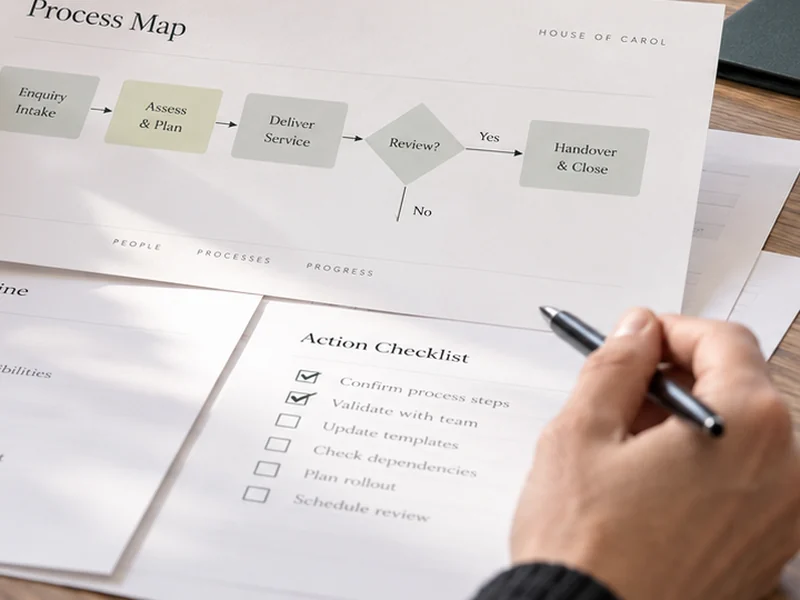
A clear view of how complaints enter the organisation and move into the process.
Rules for what enters the complaints process and how it is acknowledged and routed.
Defined investigation stages, evidence responsibilities and decision ownership.
Clear points at which a conflict, independence concern or specialist referral needs to be recognised.
Response standards, escalation and review steps, and a defined remedy and closure route.
A learning and root-cause loop, with records and responsibilities made visible.
One focused correction cycle is included following review.
WORKED EXAMPLE
Example situation: For organisations that need a clearer route through intake, investigation, response, remedy, closure and learning.
We would start with what is happening now and the information already available, then work through the service described on this page. If the problem needs a different route, we would say so before broadening the work.
A clearer result: The outcome
What you could receive: Current-state and intake map, Eligibility and triage criteria, Investigation and evidence route, Independence and conflict triggers, Response, review and remedy route, and Learning and ownership map.
Illustrative example — shown to explain how the service can be applied. It is not a customer testimonial or measured result.
The commercial shape
The exact boundary, timetable and fee are confirmed before commitment.

Your current complaints policy or process information, relevant sector context and an accountable owner for the future process. The planned turnaround begins once the agreed inputs are complete.
House of Carol does not act as an ombudsman, regulator, judge or adjudicator, make legal liability findings, decide disputed customer rights or promise a particular remedy or outcome.
Statutory complaint rights, required independence, safeguarding or vulnerability issues and legal-liability questions remain with the appropriate customer authority or competent specialist.
It fits an SME or charity whose complaint handling is inconsistent, difficult to trace or poor at turning individual cases into organisational learning.
If your existing process is already clear, consistently followed and appropriate for your sector, a smaller internal review or guidance update may be more proportionate.
No legal correctness, regulator acceptance, complaint result, remedy or measured customer benefit is guaranteed.
FROM INTEREST TO A CLEAR DECISION
Start with the problem, not a purchase decision. We will check whether this service fits before anything is agreed.
Share the problem you are trying to solve, what you already have and any deadline or constraint that matters.
We check the scope, the information we would need, the fee and whether this is genuinely the right service. If it is not, we will say so.
Nothing starts until you know what is included, what is not, what you need to provide and what happens next.
There is no pressure to add another service. The useful next step is simply to decide whether this one solves the problem in front of you.
Next step
Tell us how complaints currently arrive, who owns the process and where the handling breaks down. We will first check whether the service fits your situation and confirm the proposed scope, price and planned timing before any commitment.